For baseball parents · Ages 8 to 12
Is my kid too young to train?
Fair question. Kids this age can train. It just has to look different. The Baseball Power Program: Youth Edition is 24 weeks of two 30 to 45 minute sessions a week, written out for parents to run.
Not sure yet? Get Weeks 1-2 free
- Weeks
- 24Weeks
- A week
- 2xA week
- Minutes
- 30-45Minutes
- Pages
- 43Pages
The honest answer
Built for kids, not shrunk-down adults.
Before the growth spurt the goal isn't max strength. It's movement skill: landing, sprinting, cutting, throwing a med ball and owning their own bodyweight, so they're ready when the strength shows up.
The safety rules come from published position statements on youth training, including the National Strength and Conditioning Association's, the American Academy of Pediatrics' and the 2014 International Consensus, all listed at the back. The structure is M4P's. Where something is our own coaching convention rather than published research, the page says so.
Month 1 looks easy on purpose. Every lift is bodyweight, because load is only ever added to clean movement.
Named organizations are sources, not endorsers. None of them has reviewed this program.

Connor Jenkins
Founder of M4P · coaches 14U and 15U · directs a high school program
As a player: ranked No. 496 in the country, the No. 1 outfielder and No. 3 player overall in Missouri, with a 9.5 grade from Perfect Game. Division I commit.
Center STL, St. Louis
The guardrails
The rules in this house.
- An adult watches every session: a coach, or a parent who has read the technique pages.
- The Readiness Check comes before Month 1, and again before the first dumbbell or kettlebell.
- Weights are picked by reps, not pounds: every rep clean, with about 2 left in the tank.
- Pain stop-rules for the arm, heel, knee and low back sit on every session page.
- Med balls stay at 1 to 2 kg (2 to 4 lb). Every Day 1 and Day 2 session has printed easier versions to drop to.
- The Weekly Load log counts practices and games, with at least one full day a week of no organized sport.
- They compare themselves only to their own past numbers. Kids grow on very different timelines.
What a session looks like
30 to 45 minutes, in the same order every time
Warm-up game
4-5 min
Dynamic warm-up
5 min
Speed or agility drills plus a game
8-10 min
Jumps and throws
4-6 min
Strength in pairs, with arm care and core
12-15 min
Cool-down
3-4 min
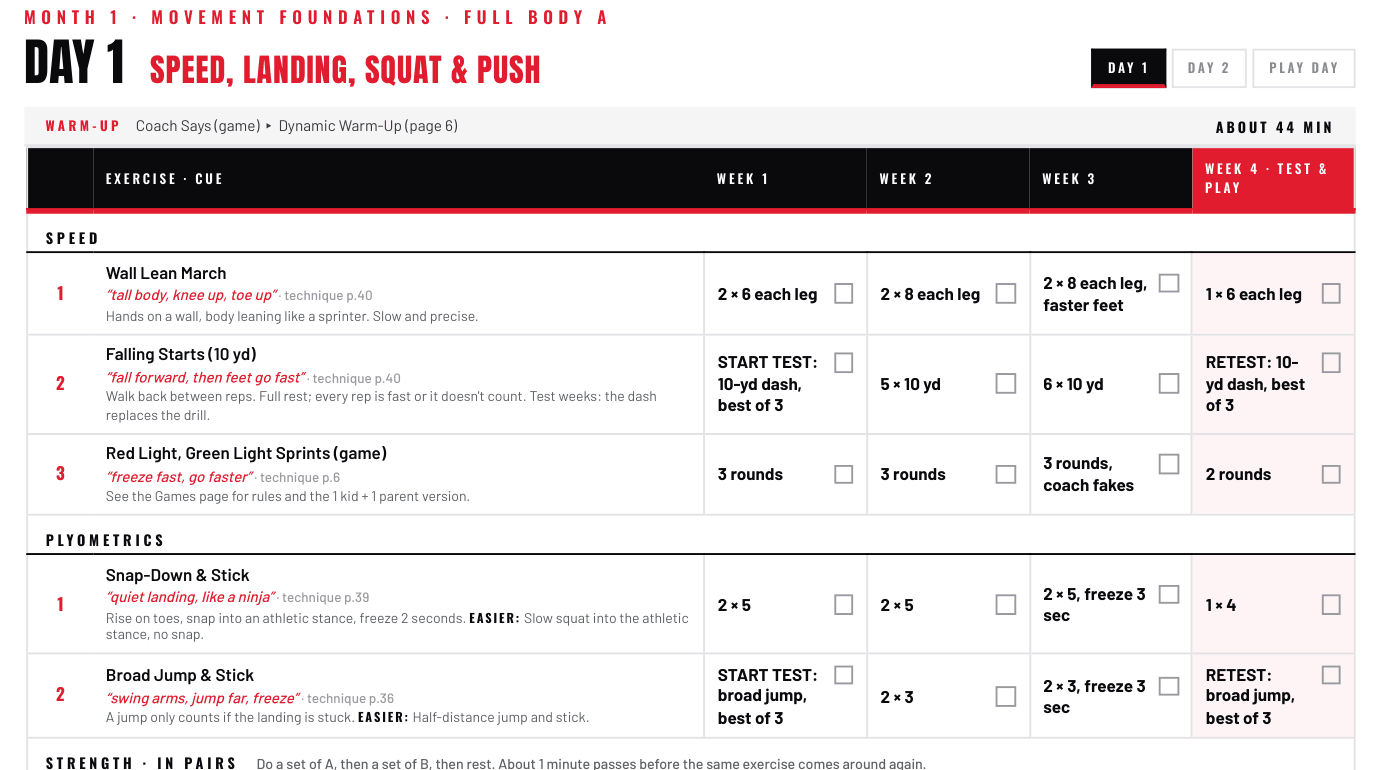
Two full-body days a week, 48 to 72 hours apart, plus an optional Play Day in the off-season. Week 4 of every month is Test & Play: less work, a game, and the fun tests in Months 1, 3 and 6. Each session gives you the one cue to say, with the technique page beside it.
Where: 15 to 20 yards of grass or turf for sprints, jumps and games, not a concrete garage floor. The strength pairs fit in a garage. Just one kid and one parent? The games have a version for that.
The six months
One job a month.
Weeks 1-4 · Movement Foundations
Learn to move
The six patterns every athlete builds on, and how to land quietly. Bodyweight only for every lift.
Weeks 5-8 · Strong Positions
Own every rep
The same positions under light load: first dumbbells and kettlebells, only after the Readiness Check is passed.
Weeks 9-12 · Fast Feet
Quick and controlled
Quicker feet, crisp turns, single-leg hops that stick, and rotational med-ball throws into a wall.
Weeks 13-16 · First Step
Win the first three steps
Arm action, body lean, base-stealing starts and quick hurdle feet, backed by single-leg strength.
Weeks 17-20 · Jump & Throw
Hips power everything
Real-effort jumps with stuck landings and crisp med-ball throws, connecting the hips to the hands.
Weeks 21-24 · Game Speed
Show it off
Lower volume, highest intent: reaction, baserunning speed and power, then the final test day.
When the spurt starts
Growth-Spurt Mode
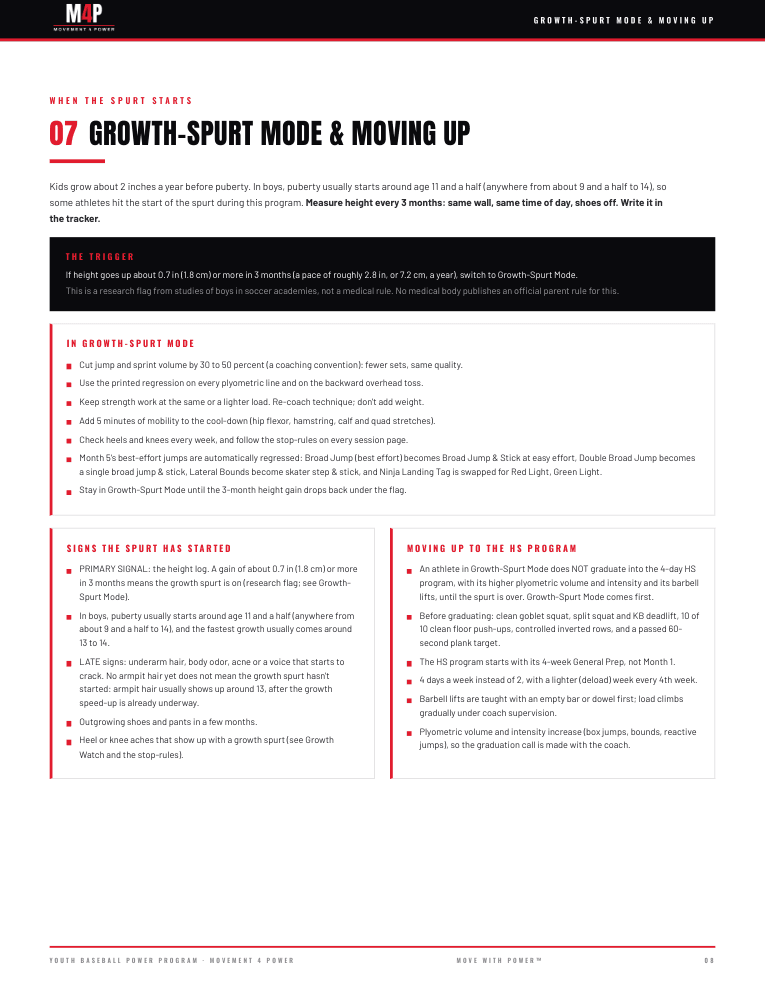
Measure height every 3 months: same wall, same time of day, shoes off. If it goes up about 0.7 in (1.8 cm) or more in 3 months, the program tells you to switch modes.
- Jump and sprint volume comes down 30 to 50 percent (a coaching convention): fewer sets, same quality.
- The printed easier version on every plyometric line.
- Strength work at the same or a lighter load: re-coach technique, don't add weight.
- Five extra minutes of mobility, and a weekly check of heels and knees.
That trigger is a research flag from studies of boys in soccer academies, not a medical rule. No medical body publishes an official parent rule for this, and the program says so on the page.
What we skip, and why
Six things you will not find in here.
Max-out lifts
They aren't needed at this age. A broad jump and clean reps tell us what we need to know.
Reps to failure
If the last reps look different from the first, the session drops to the printed easier version.
Weighted-baseball throwing
The program never uses weighted baseballs. Light 1 to 2 kg med balls for chest passes, slams and tosses are not weighted-ball throwing.
A throwing program
The team handles throwing. You get the Pitch Smart table for ages 7 to 12, and the rule to follow it or your league's limits, whichever is stricter.
Supplements
Food, water and 9 to 12 hours of sleep. No supplements, no creatine, no pre-workout.
Punishment reps
Jumps, sprints and push-ups are never a punishment, in the program or in its games.
What's inside
Written for the parent running it.
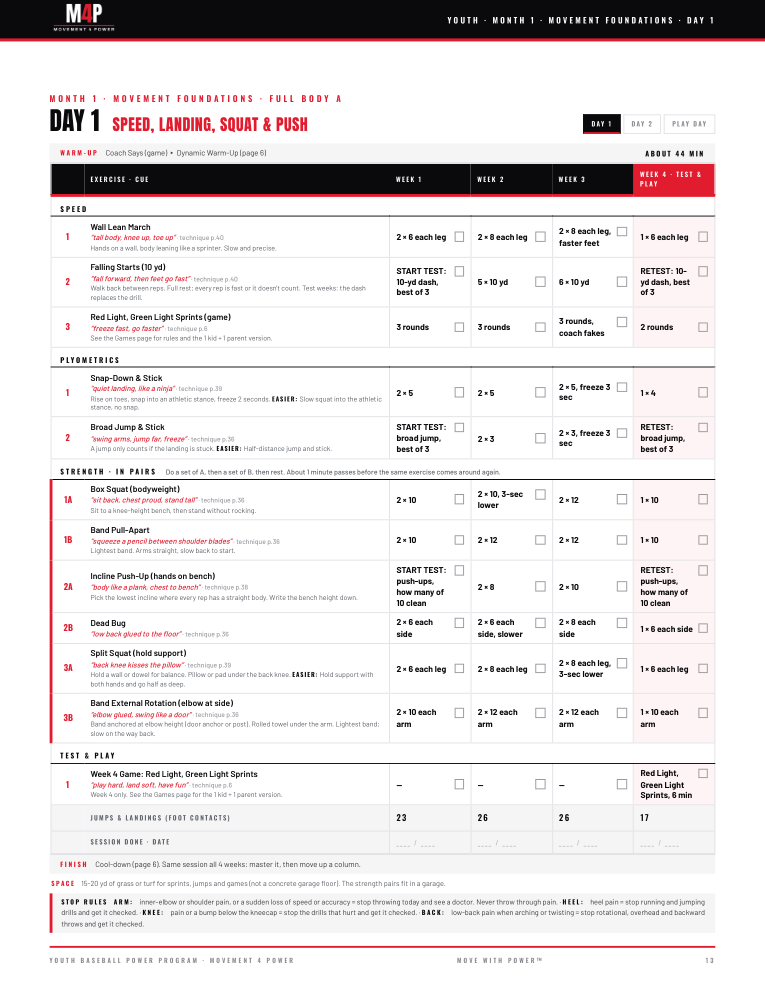
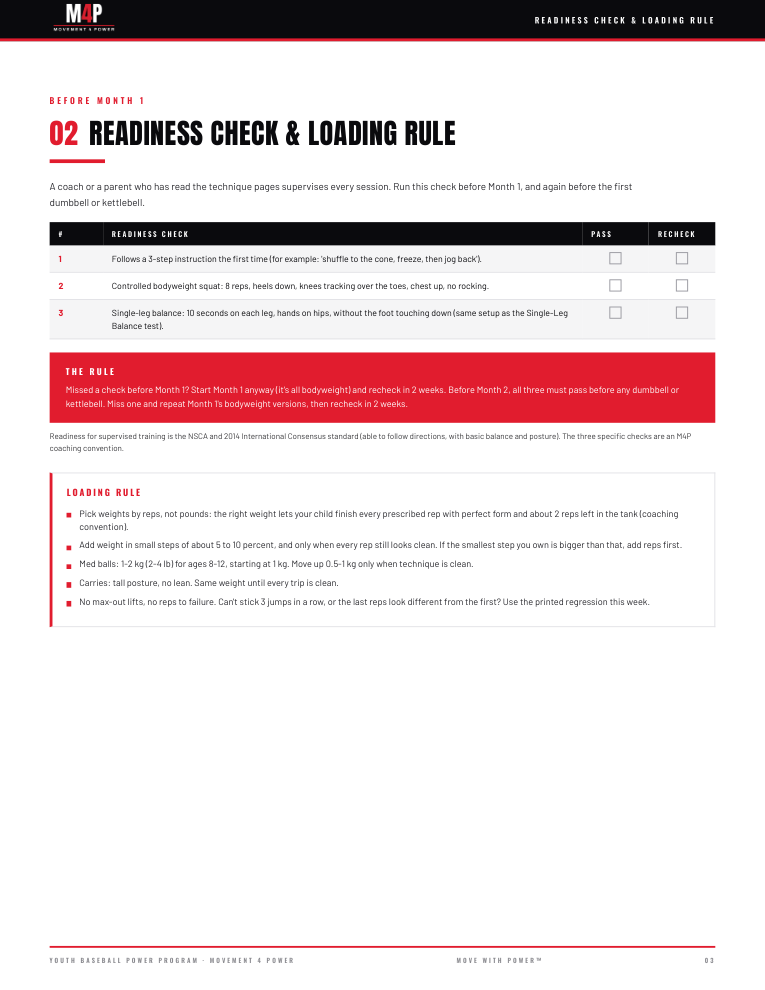
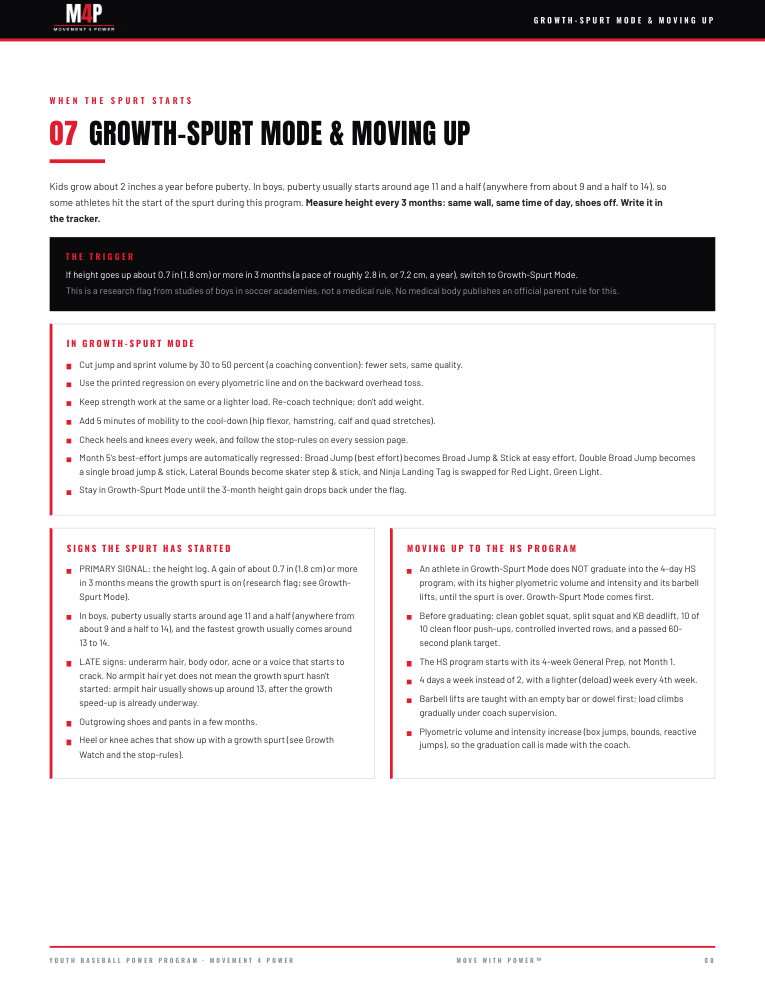
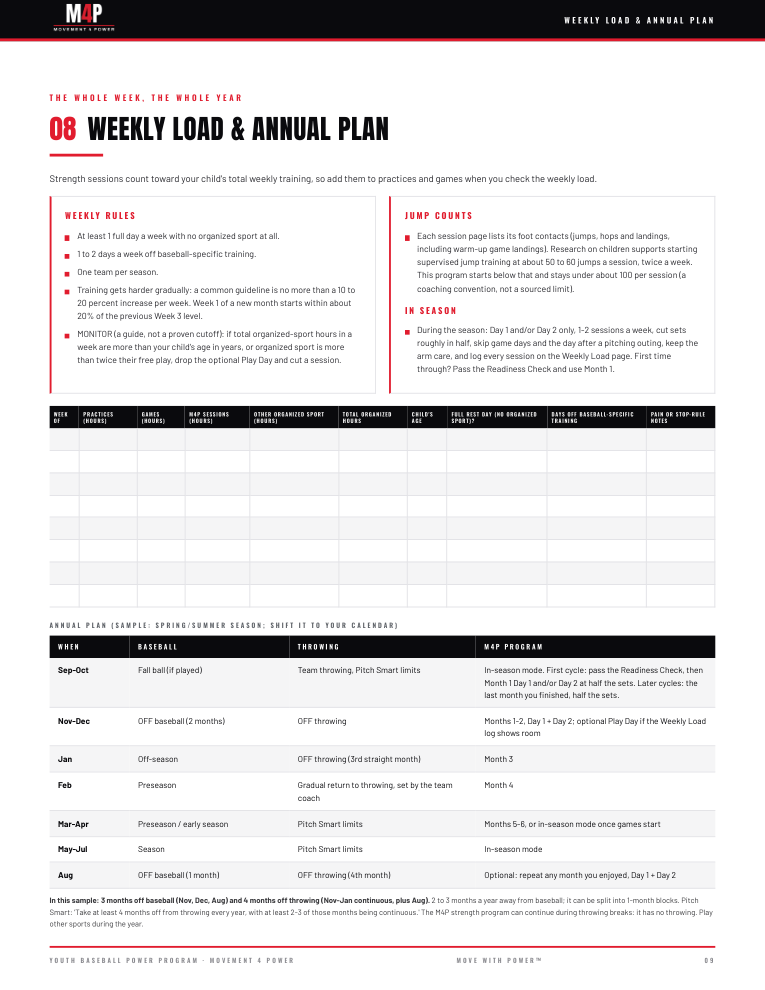
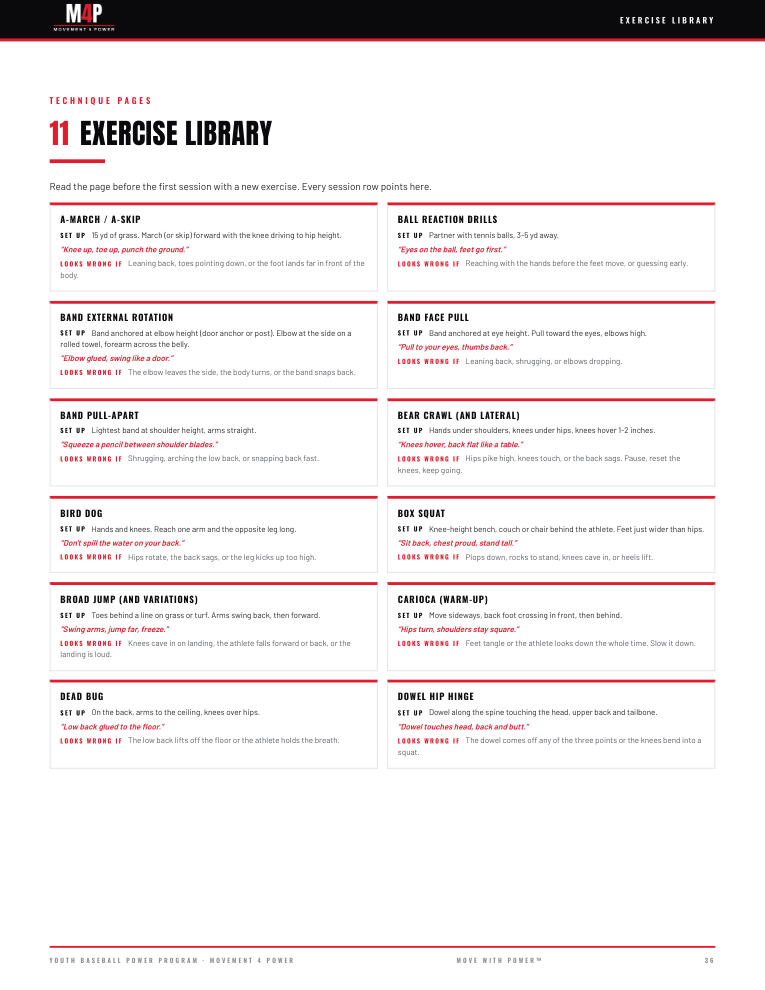
Real pages from the 43-page PDF. 23 sources are listed at the back.
Honest about its limits.
- Not a video course. It is a PDF: each exercise has a written setup, a cue and what wrong looks like, and there are no video demos.
- Not a throwing program. The team handles throwing.
- Not hands-off. An adult runs and watches every session.
- Not medical advice. Get clearance from your child's physician first, especially with a past injury or medical condition.
- Exercise carries a risk of injury. This is general information for healthy athletes, not a safety guarantee.
Want to see a session first? Get Weeks 1-2 free
The offer
Everything you get for $67
- 24 weeks across six monthly blocks: 2 full-body days a week, 30 to 45 minutes
- An optional off-season Play Day and a Test & Play week every month
- Readiness Check, Loading Rule, Growth Watch and Growth-Spurt Mode
- Weekly Load log, Annual Plan and the Pitch Smart table for ages 7 to 12
- A 55-move Exercise Library with cues, plus fun tests and a tracker
30 days to decide
If the program is not what you expected, email us within 30 days of purchase and we will refund it in full. You do not need to return or delete the file. That is the same refund policy every M4P digital program carries. See our terms.
For comparison, at M4P today
- One 4-week M4P program$59
- The Youth Edition: 24 weeks$67
48 core sessions for $67 is about $1.40 a session. Different products, real prices: what each one sells for on this site.
Delivered by email as a PDF. Card payments: usually within a few hours. Bank payments: once they clear, which can take a few business days. Nothing by the next morning after a card payment? Reply and we will fix it. Read it on a phone or print it.
Questions
Before you order
Is my kid too young to train?
For most healthy kids this age, supervised training is reasonable. Check with your pediatrician first. If they can follow a 3-step instruction, the Readiness Check tells you where to start. Month 1 is bodyweight for every lift, and missing a check before Month 1 just means starting anyway and rechecking in 2 weeks. Before any dumbbell or kettlebell, all three checks must pass.
What will they actually be doing?
Two 30 to 45 minute full-body sessions a week: a warm-up game, speed or agility drills, jumps and throws, strength in pairs, and a cool-down. It fits around practice, and Week 4 of each month is Test & Play.
Do I need to know anything about training?
No, but you do need to read it. A coach or a parent who has read the technique pages supervises every session. Each line gives you the one cue to say, and the Exercise Library shows the setup and what wrong looks like.
Are there video demos?
No. The program is a PDF. The 55-move Exercise Library covers each move in writing: setup, cue and what it looks like when it goes wrong.
What equipment do we need?
Month 1 is mostly what you already have: a phone timer, tape measure, shoes for cones, a broomstick, a sturdy chair, a pillow, tennis balls and a basketball for chest passes. You will add the lightest long band, a soft 1 kg med ball and slam ball, and a playground bar or anchored straps for rows. Light dumbbells and a kettlebell come in Month 2, and the Equipment page lists each month's additions.
Does it use weighted balls?
No weighted baseballs, ever, and no throwing program: the team handles throwing. It does use light 1 to 2 kg med balls for chest passes, slams and tosses, starting at 1 kg, and they never go above 2 kg (4 lb).
What about during the season?
The Weekly Load page covers it: Day 1 and/or Day 2 only, sets cut roughly in half, no game days and not the day after a pitching outing. The Annual Plan shows a sample year, because the program does not run year-round.
My athlete is 13 or 14.
It comes down to growth, not the birthday. The Youth Edition is built for before and at the very start of the spurt. An athlete in Growth-Spurt Mode stays out of the 4-day high school program until the spurt is over, and the graduation checklist is in the book. The high school program then starts with its General Prep, and that call is made with a coach.
When do I get it?
Your download link comes by email. Card payments: usually within a few hours. Bank payments: once they clear, which can take a few business days. Nothing by the next morning after a card payment? Reply and we will fix it. The link works for 30 days, and the file is yours to keep.
We are in St. Louis. Should we just book an assessment?
If you can get to Center STL, an in-person assessment is the best next step. It measures movement, power and skill, and you get a written plan built around your athlete.
In St. Louis? See the in-person assessments.
Want to try it first?
Weeks 1 and 2 are free for parents: the parent rules, the warm-up game, the sessions with no-gear swaps, and the fun tests.
Get Weeks 1-2 freeTraining a high school player?
The full Baseball Power Program is 4 days a week in a gym with a rack.
See the high school program